
The Devil's Chord – Chapter 15
Overcoming friction
Playing a stringed instrument well requires many skills. Fine motor skills; a superb sense of timing and rhythm; musical knowledge practised so often it becomes musical instinct; accurate audiation – thinking in music; a laser focus on the minutiae of playing your instrument.
One of those minutiae is the importance of friction, and overcoming it. Friction slows your picking, plucking, strumming or bowing hand. It can throw you off tempo, make you miss notes. It can introduce ugly squeaks and grating sounds to your playing. Most of which are only audible to the player – but a true instrumentalist strives insatiably to please her own ear.
Bluegrass stringed instruments generally use steel strings for a bright, loud sound: nickel-plated plain steel, or sometimes stainless steel.
Those steel strings operate in a tough environment. They may be struck hundreds of times a minute, for an hour or more at a time: by the hard keratin of nails; by the harder synthetic material of a plectrum; by the nickel silver or, hardest of all, stainless steel of fingerpicks. The musician sweats, often profusely, under the stage lights and the pressure of performance. Sweat, dust and tiny flakes of skin create an acidic grime that accumulates on strings. It’s corrosive and sticky.
Bluegrass relies on fast, accurate picking: so fast you can’t count the individual notes. But the notes are there, and they have to be the right notes, struck with the right pressure and inflection at the right instant, with a millisecond margin of error. If your strings are corroded or sticky, they grab at your picks, bow hairs or fingertips. Fast, accurate playing becomes impossible. Missed notes and bum notes eventuate.
Friction also creates heat, and heated strings expand, necessitating frequent retuning.
So friction is our enemy. To overcome friction, we keep our strings smooth and clean, we change them often, and we use lubricants.
Fiddlers rosin their bows; banjo, guitar and mandolin players oil their strings. These oils are typically a proprietary blend of fine mineral oil and botanical oils such as jojoba.
Toby Reid is a bluegrass mandolin player at the highest level, and fastidious about string care to the point of obsession. He’ll restring his own instruments and play them in before performing, rather than leave it to his instrument technician. He’ll lubricate his strings before, during and after a performance, using the special applicator he keeps in his gig bag.
One end is the hollow handle, containing a cloth for wiping your strings clean; the other end is an impregnated felt pad. It’s ideal for applying a thin coating of lubricant to your strings quickly, without mess or fuss.
Coincidentally, we use the same popular brand, he and I.
What is applied to your strings inevitably gets on your fingers. What gets on your fingers may get into your body.
It can be absorbed through your skin and reach the fine capillary vessels that carry blood, oxygen, nutrients and hormones to your vital organs. Alternatively, your fingers may touch your mouth, or something you then put in it.
So obviously, you wouldn’t want anything toxic in your string lubricant, would you?
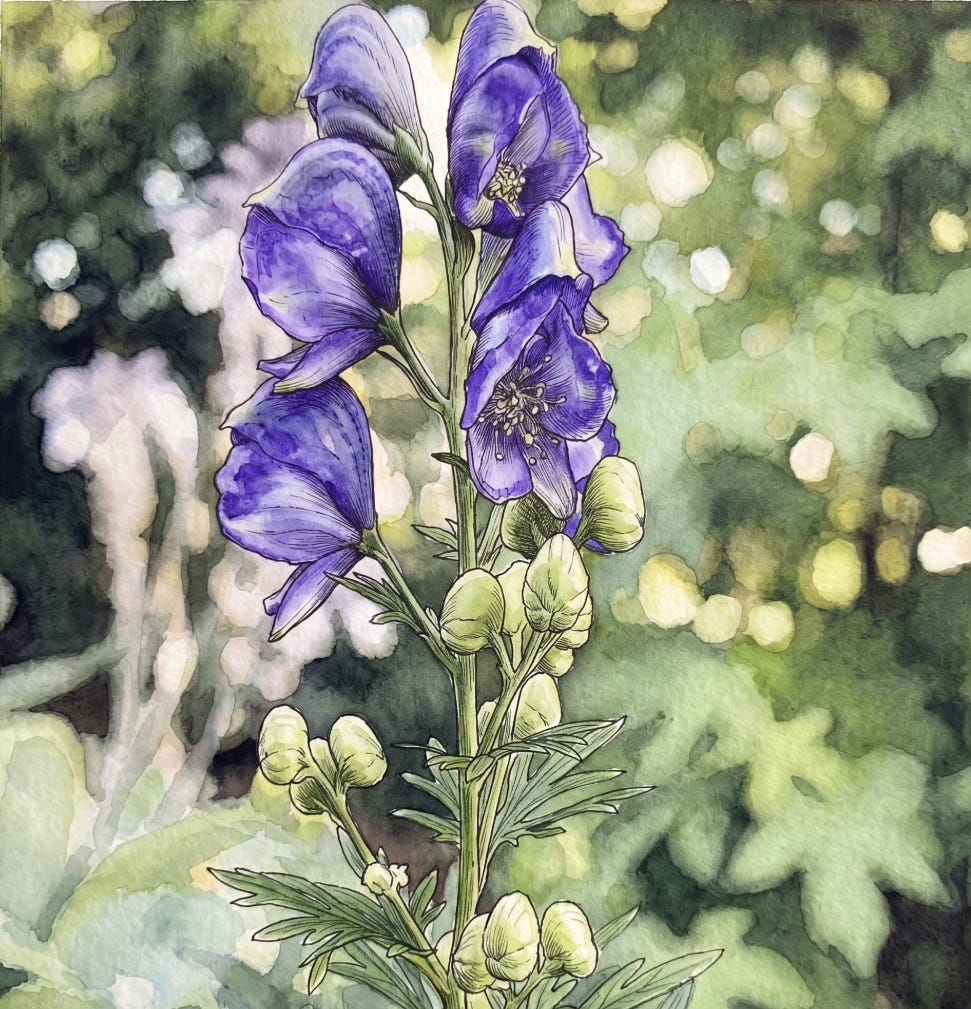
The tall, graceful herbaceous perennial monkshood is pretty, an ornament to any cottage garden, including mine. Though delightful to look upon, it’s far from innocent: it’s the most poisonous plant native to Europe. It contains a range of neuro- and cardiotoxins, the most lethal of which is aconitine, which dramatically slows the heartbeat and paralyses other vital functions. Some call it the Queen of Poisons: it has been used to poison blades and arrowheads since ancient times.
Hence its other name, wolfsbane.
It’s most effective when ingested, but is also readily absorbed via the skin, especially through prolonged exposure. Initial symptoms may occur within minutes. They include sweating, nausea, dizziness and confusion: similar symptoms to alcoholic or other recreational drug intoxication. Heart arrhythmia and respiratory paralysis ensue. Then death. There’s no antidote.
So you can see how, hypothetically, a tincture of monkshood in your string lubricant might not be a healthy thing, can’t you?
Heart failure is not uncommon in sixty-year-old males who’ve been drinking and partying hard for decades and used to be heavy smokers; who keep irregular hours, eat poorly and travel a lot for work. Especially if that work is stressful and physically demanding. If they also work out too vigorously in the gym, with maybe a little steroid use to improve results … well, that’s unwise.
It’s easy to see how that kind of lifestyle could lead to heart problems, isn’t it?
The Pick always ends early on the Sunday: some of our audience and musicians have to get home, wherever home may be, in order to be back at work on Monday morning. Poor souls. So we wrap up at ten, with the smaller venues closing at six. Usually our headliners start the last session, at seven, on the main stage.
When I make my way to the Multifunctional Space to watch those final sets, and deliver the closing speech at the end of the night, there’s a steady stream of vehicles leaving the oval next door, heading down the hill out of town. A red river of tail lights.
As president, I can wander at will backstage at any of the venues. In the wings, in the green room, in the instrument lock-up. I can chat freely with the performers, the technicians, the volunteers. My role is not just that of a figurehead, after all: we’re too small a committee for that. I take a practical, hands-on interest in all aspects of the smooth running of the Pick, and as a former professional musician and music teacher, I’m habitually curious about musical instruments and paraphernalia.
So my presence in any of these backstage areas is unremarkable and unlikely to arouse interest. After all, the other people backstage are usually busy, and preoccupied with the tasks they have to carry out.
Of course, we don’t chuck our musicians out unceremoniously when the Pick is over – heaven forbid! There’s an afterparty: more subdued than the wild, firelit bacchanalia of Saturday night, but relaxed and good-humoured. We’re all friends now, after all. All the performers, lighting and sound crew, MCs and roadies are invited, and many attend. Free beer is free beer.
We hold the afterparty in the Vault, formerly the Colonial Bank of Australasia, now a cute little wine bar, with a brick-paved courtyard garden. Between the courtyard’s ivy-clad walls, a brazier takes the edge off the cool night air. Couples are dancing to the music of a scratch band, comprising a few hardy musical survivors who aren’t played out yet.
I’ve been standing there only a few minutes, sipping at my wine, making small talk and indulging in mutual congratulation with volunteers and performers on a festival well held, when Toby eases his way through the crowd, beer in hand and a sheepish expression on his face.
‘Meggsy,’ he murmurs in my ear, just loud enough to be heard above the hubbub of voices and music. ‘I’m so sorry.’
‘Oh?’ I answer, with just the right degree of coolness. I let him steer me into the relatively quiet corner by the side gate.
‘For what I said earlier.’ He sighs, hesitates. ‘You were wrong, but I can see now how you might have thought … all that. Anyhow, I shouldn’t have said what I did. It was unkind. Cruel. Can you forgive me? Can we still be friends?’
‘Course we can, you daft sod,’ I reply, after a calculated pause, and with a micro-dose of residual hurt in my smile. ‘But by way of making amends, and as your president, I insist that you give me the next dance.’
He’s an excellent dancer. That’s something else I’ve missed. We have three dances in a row.
‘So, next stop Geelong?’ I say, as we leave the dance floor.
‘That’s right. Heading on down the Hume Highway tomorrow after breakfast.’
‘Then after Geelong, back home to Kentucky?’
‘Uh-huh. Home to Paducah for Thanksgiving with the folks.’
‘Lovely.’
‘Then we’ve got some studio time booked, in the run-up to Christmas. In the New Year, I might get over to New York.’
‘Nice.’
‘Your Niamh will be there by then, of course, and I’ve kinda promised to show her around. Help her settle in.’
‘Oh, I think she knows New York quite well. She’s been a few times, you know, over the years.’
‘Sure, sure. But I lived there for eight years, in the Upper East Side. There’s no substitute for local knowledge, contacts. And I’ve still got a cabin upstate, on Lake Placid. It’s beautiful there, in the snow.’
‘I’ll bet it is. Sounds wonderful. Cosy.’
‘It wouldn’t bother you?’
‘No, of course not! Why on Earth should it?’
I can see he’s unsettled by my equanimity. Let him be.
‘I probably won’t see you in the morning, before you go,’ I continue. ‘So take care, Tobes, and enjoy the rest of your trip.’
I accept the hug, and whisper in his ear, ‘And thank you, for old times’ sake.’
Next Tuesday in The Devil’s Chord: It’s the day after the Pick. Meg decides to remove herself from the situation.
Title artwork ‘Aconitum napellus’: created in Gemini 3.1 with Nano Banana 2 using a reference photo from pixabay.com.
Be still, my beating heart. Not that still ...
Nicely done. I didn't see that coming 😆