
The Devil's Chord – Chapter 3
Coffee morning
Tuesday morning, and no time for gardening today. I’ve agreed to an interview over coffee with a regional paper, to talk about the Pick. One of my many diverse duties as president. There are only six of us on the committee, so everyone has to muck in.
I thought that actual, real-life, analogue journalists were a thing of the past, having been replaced by bloggers and AI, or AI bloggers. But it seems I was premature. This chance for a bit of publicity for our Silver Creek Alpine Pick is to be seized.
I prefer to take on the press on neutral turf, rather than bring them into my home. So I’ve arranged to meet Ruth Onyango in the Lemon Tree Bakery, the lower of our two cafés, topographically speaking.
It’s an opportunity for her to get a sense of our little town before the madness of SCAP begins, I told her. Well, the sedate madness of a couple of thousand elderly musicians and music lovers descending on a town of five hundred for a long weekend.
I’m here, she texts me, five minutes ahead of schedule. You won’t have any trouble spotting me.
She’s right. In a Venn diagram ‘Very Unlikely to be Called Ruth Onyango’ and ‘Lycra-clad Cyclist’, there’s only one guest at the café I would plot outside both circles. She’s a pretty black woman half my age, wearing blue stretch jeans and a strappy top with bright geometric patterns.
She rises to shake my hand: ‘Hi, I’m Ruth. Is this table okay for you?’
It is. I catch Justin’s eye and we order our coffees.
Ruth Onyango is good at her job. I can tell that straight away, without reading a line she’s written. She has a way of leaning in, a sparkle in her gorgeous brown eyes, a conspiratorial sense of fun calibrated to coax more from her interviewees than they mean to divulge.
I’m not silly, though, and this is very far from my first rodeo, Ms Onyango.
She places her phone on the table. Is it okay for her to record the conversation? Of course it is.
Why is the Pick important for the town? Why did I get involved? Why bluegrass? What’s the attraction of Americana for Australian audiences?
I wheel out my standard responses.
‘There are a lot of affinities between rural America and rural Australia. Dig a little deeper and you’ll find music that speaks to the common human experience, from a time when life was harder and choices were starker. “Three chords and the truth,” as the saying goes.’
‘The truth? So it isn’t nostalgic music for an elderly white audience, then?’
The directness catches me off guard.
‘Oh, you’ll see young faces here this weekend,’ I fudge. ‘And we’re a multi-ethnic bunch.’ I frantically review the list of performers in my mind’s eye. Yes, there are definitely two or three Asian names. Do we have any First Nations performers?
This journo’s nobody’s fool. Maybe I should have left the interview to Reda, after all?
‘Awesome. But why? What’s the attraction for the young crowd? Of this old-fashioned music?’
Goodness, you are direct.
‘You’ll find young musicians playing bluegrass in city bars across Australia. It’s exciting music to play: at once very simple, with the three-chord structure, the major key, the simple AABB sequence. But that’s just a blank slate, a foundation for amazing technical skill. Blazing fast, arpeggiated, syncopated playing, off-the-cuff improvisation that looks like a throwaway, effortless thing – but it’s the result of years of dedication, devotion to precision …’
Ruth nods politely. Her pupils are contracting. I should so have left this to Reda Mansouri.
‘Then there’s the newgrass aspect,’ I try. ‘The bluesier, rootsier end of the bluegrass spectrum, with new perspectives that are maybe more relatable to a young, modern, urban audience, one with an environmental and social conscience. Perhaps.’
‘Okay … So who should I watch out for, this weekend? Any tips?’
She’s actually going to stay for the festival? Good Lord, surely that’s above and beyond the call of duty. I suggest some names, run through a few bios.
‘So no rhinestone cowboys and cowgirls?’
‘Oh, yes! Don’t you worry about that. Bluegrass has its daggy side – the ten-gallon hats, the boots, the big belts and high waistbands. The genre doesn’t take itself too seriously, and Australian audiences relate to that, I think.’
Daggy? Did I really say ‘daggy’?
Festival Director Dubs Acts ‘Daggy.’
‘Then there’s the old-time component. The old, traditional music with the strong Appalachian roots: banjo, fiddle, guitar, mandolin and dulcimer. Close harmony singing. Playing around a single condenser mic. This music grew up as a blend of African-American, Anglo-Celtic and Native American cultures and storytelling.’
‘Fascinating. So that brings us to the ethnic and political aspects, if you’re comfortable talking about that,’ she says sweetly, and I swear I hear the sound of a trap clicking shut.
Erasure of Black artists. Cultural appropriation. Lack of female representation. The problematic persistence of murder ballads. Tenacious patriarchal values. Southern White cultural narratives. She’s done her homework.
I think I give a good account, and can set her straight on a few points. I mention Jake Blount, Rhiannon Giddens and the Carolina Chocolate Drops. The Ebony Hillbillies. Adia Victoria.
‘And murder ballads? Your average evening’s viewing on free-to-air contains more gendered violence than a whole weekend programme here. Why the pearl clutching over a few traditional songs? Don’t we trust ourselves to understand context any more?’
Festival Director Dubs DV Killing Outrage ‘Pearl Clutching.’
Truth be told though, this really isn’t my circus. I just happen to like the music. I have no desire to become an evangelist for it, let alone an apologist. I fell into the role of president of BOTMS when my predecessor died and I ran out of excuses.
‘So you’ve lost your headline act?’
I’m relieved at the change of direction, but where in the world did she hear that? Who else has she been talking to?
‘Yes, such a shame to lose the Cropdusters. Luckily we’ve got a replacement band who were able to jump in at very short notice. A very well-known band from Kentucky. More towards the newgrass end of the spectrum that I was talking about earlier.’
‘Ah, yes. Toby Reid’s Hell ’n’ High Water.’
‘How did you even know about them? The website hasn’t been updated yet. I’m sending out an email when I get home.’
The conspiratorial giggle. ‘Oh, I have my sources.’
Suddenly it doesn’t seem so charming.
‘I understand that you and Toby and your husband Ken were once in a band together.’
‘That’s right. But it was a long time ago and really, only for a short time, just a silly thing we did in our youth.’
‘Yet there was some ill-feeling about the break-up. How did you put that behind you?’
‘We’re straying into personal territory,’ I say, as lightly as I’m able, ‘and I’d rather not go there, if you don’t mind.’
‘Fair enough.’
I look pointedly at her phone on the table.
‘Deary me, is that the time already? You’ll have to excuse me, I’m afraid. There’s so much to do.’
She nods indulgently, thanks me for taking time out of my busy schedule. If she’s miffed at the interview being cut short, she doesn’t give anything away. Maybe I’ve given her enough.
‘I’m sure we’ll bump into each other again during the weekend,’ I say. ‘Enjoy the Pick – and make the most of this lovely spring weather while it lasts.’
‘Thanks,’ she says. ‘I will.’
I’m not sure quite at what point in the Maleny weekend it became clear we were sharing more than a tent. Did it just happen, or was it discussed between the two boys? I never pressed Ken on that point; he probably doesn’t even remember now.
To me, it just felt like a cosy arrangement we fell into. We went with the flow. It was so easy and natural at the time.
It was the same with the band. By the end of the weekend, it was sort-of-agreed that we’d be forming a band together; just the three of us for now.
You see, Toby and Ken’s former outfit never really recovered from the knockback by the festival organisers. Failing to make it onto the list of three hundred performers deemed worthy to perform at the Folkie … It was hardly an endorsement.
I think in retrospect, there was nothing wrong with the music they were playing. It was just that nobody could work out where it fitted in. It wasn’t folk, it wasn’t roots rock, it sure as hell wasn’t country – and it wasn’t what Aussies still thought of as bluegrass in those days, all spangly duds and old-fashioned high-speed playing.
Was it bluegrass-inflected acoustic jazz with punk overtones? Or those genre labels in another order?
I don’t think the other band members, the bassist, the accordion player and the lead guitarist, whose names I’ve forgotten, even knew.
Anyone who followed Béla Fleck at that time, when he left the New Grass Revival and founded the Flecktones, would have recognised affinities in some of Toby and Ken’s music, but that was a niche area even for Fleck to explore on his US home turf, let alone a bunch of unknowns on the other side of the planet.
At any rate, a classically-trained violinist fitted in just fine with the experimental slap-banjo and flamenco mandolin weirdness.
We stayed in Queensland and the Northern Rivers throughout the winter: writing songs and rehearsing, busking and doing bar shifts, putting together a demo tape and landing the occasional paid gig. Toby was eager to take us over to the States, where he had connections, so he said, and you could actually make a living playing music without selling out to the commercial mainstream.
We had our plane tickets and some tour dates lined up; a recording session on Music Row, no less.
Then one bright afternoon an over-zealous cop pulled Ken and me over for speeding, on the highway outside Dubbo. He took one whiff as I reluctantly wound down the window, and before we knew it, we’d been arrested for possession of a threshold quantity of cannabis resin.
The timing was terrible.
It coincided with the US Immigration Act of October 1990. Drug trafficking, in any quantity, was now an ‘aggravated felony’ and grounds for refused entry or summary deportation. We took legal advice; and the advice was not to even think about flying to the USA in the current political and legal climate.
No US tour for The Devil’s Chord. No recording session in Nashville, no record company contract. No bright future in the music business.
In the end our solicitor talked the charge down to possession for personal use; we copped a fine and I avoided cancellation of my Aussie working visa by a bow hair’s breadth. After some argy-bargy with his uni and a lot of grovelling, Ken was allowed to complete his veterinary degree, which he’d put on hold for the year.
Toby, meanwhile, had left for the States, thoroughly disgusted with our ‘reckless lack of professionalism’, as he put it.
Which was a bit rich, considering it was his gear.
Back home, I redraft the email announcing the change of headliners. Show it to my hubby and get the Ken seal of approval. He might not be an official committee member, but as the president’s husband, he’s First Bloke of BOTMS. That always gets a smirk out of him.
‘How did the interview go?’ he asks.
‘Hmm, oddly. I’ll be very interested to see what kind of article comes out of it,’ I reply. ‘I can’t make up my mind whether it’s going to be a puff piece or a hatchet job.’
‘Oh. Well maybe she’ll surprise you, either way.’
‘Of that, at least, I have little doubt.’
What will Reda think?
Next Tuesday in The Devil’s Chord: Meg remembers the short, turbulent history of The Devil’s Chord. Meanwhile, preparations for the Pick gather pace.
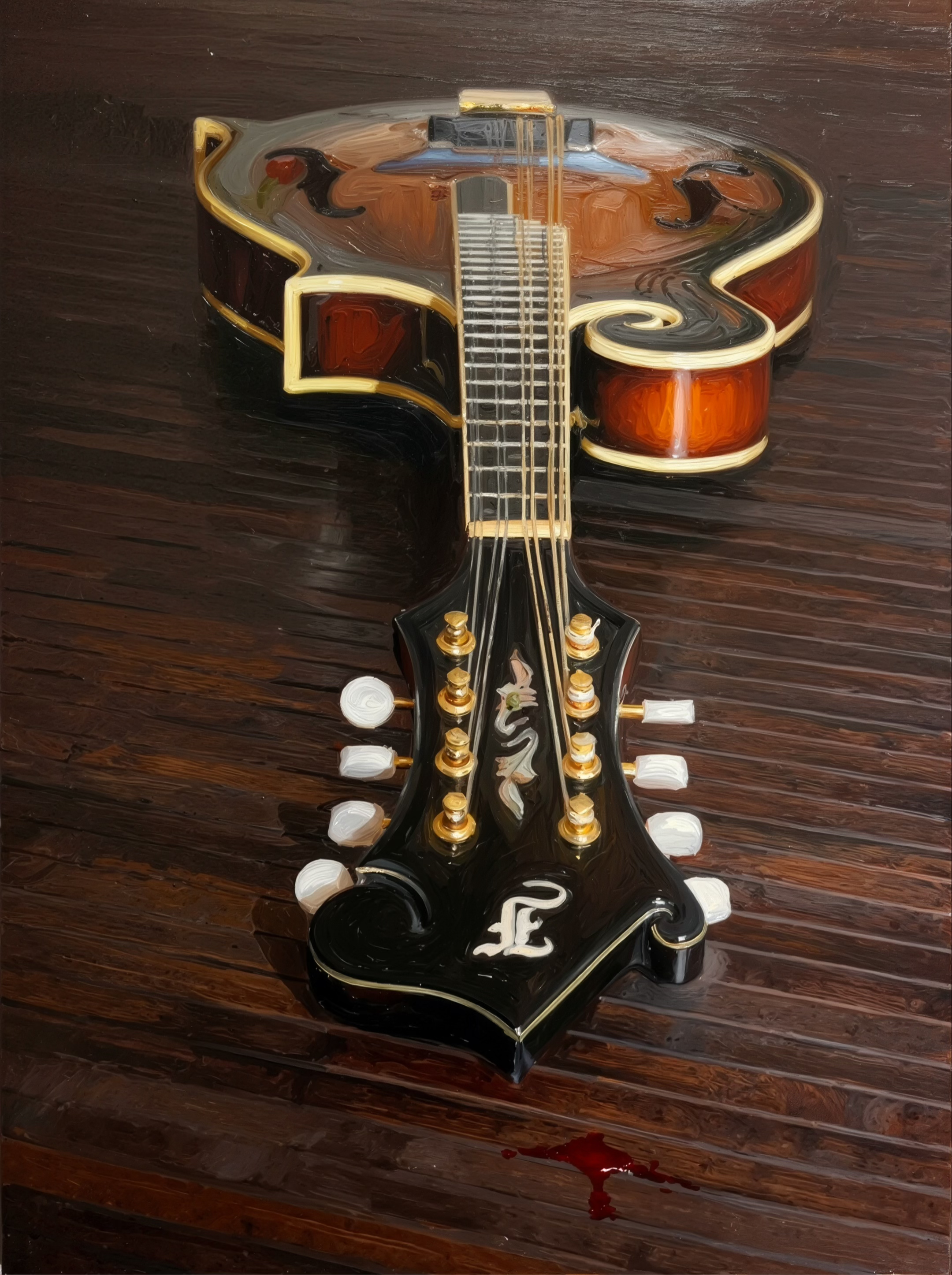
Title image: ‘Mean Mando’ from an original photo by Georg Wietschorke from Pixabay, modified by the author in Gemini 3. The prompt I used is in the alt text.
We have one brewery in Shelby. It is called Newgrass Brewery.
It’s very interesting to see how something that had happened decades ago can still deeply impact us in present day. They say time heals but no. We just get good with pushing down the memory of a past event until it is triggered again. I am waiting to see what happens when Meg, Ken and Toby finally meets again. Loving the story, Steve. 💛