
The Poynduc Podcast – Chapter 2
Uncharted territory
‘Wild’ turned out to be an understatement. What awaited me down at the shore this morning was mayhem.
Our arm of the sea is well sheltered from the power of the Southern Ocean – except when a low-pressure system bowls us a swing ball from the south-southwest. Then the swell slips between the protecting rocky headlands, sending big surf skidding down both shores and tripping with a God-almighty crash over the reef that guards the river entrance, at the very top of the bay.
Like today.
Clearly, I wasn’t going to go out in that. My Kevlar sea kayak is a tough little boat, and I’m not afraid of a bit of surf – but this surf seems to have whole trees in it. Looks like that undercut cliff further out towards Whalers Point has collapsed. Oops.
It’ll be ‘interesting’ to see how our relay buoys fare in this thoroughly nasty situation. Will our network prove another victim of the collision between meticulous human planning and doesn’t-give-a-fuck nature? Caught between snags in the water and storms in outer space …
All I can do under the circumstances is portage my kayak – my twenty-kilo kayak – over the reef and into the sheltered water of the river mouth. In here, I’ll at least be able to attend to the buoys that are inside the surf break.
Leaving the current astral shenanigans aside, floating timber is our system’s main Achilles’ heel, and we really haven’t come up with a satisfactory remedy.
‘Fortunately’, and you’re to read that word in inverted commas, dear friends, the forests upriver were so thoroughly exploited by piners in the early twentieth century that few forest giants remain.
Be this as it may, if one of the few survivors ever does rip loose from the bank and come charging downriver on the flood, its roots spread like grasping arms, it’s likely to collect our sensor system and deposit it on the reef, an expensive tangle of trash.
So, it’s a worry. If you have a solution for us, don’t be shy: drop us a DM, eh?
Portaging a four-and-a-half metre kayak in gale-force winds over weed-covered rocks is not an activity I can wholeheartedly recommend. Did I mention it weighs twenty kilos? I’m buggered.
So, before I paddle off to complete my mission, I’m just gonna find a convenient spot to sit out of the wind, take a breather and look around …
Here we go. A comfy boulder in the lee of a tall, twisted group of stringybark. The wind’s roaring in their spindly tops, but down here on the beach it’s almost still. To my right, a sandy bank extends into the shallows, lapped by wavelets, but none of the breakers crashing on the black rocks of the reef can make it to shore. The bank is studded with cowrie, cockle and scallop shells, and strewn with driftwood. To my left, the shore rises steeply into scrubby swamp paperbark woodland, with an understorey of cutting grass, which does exactly what the name suggests, and from here looks impenetrable.
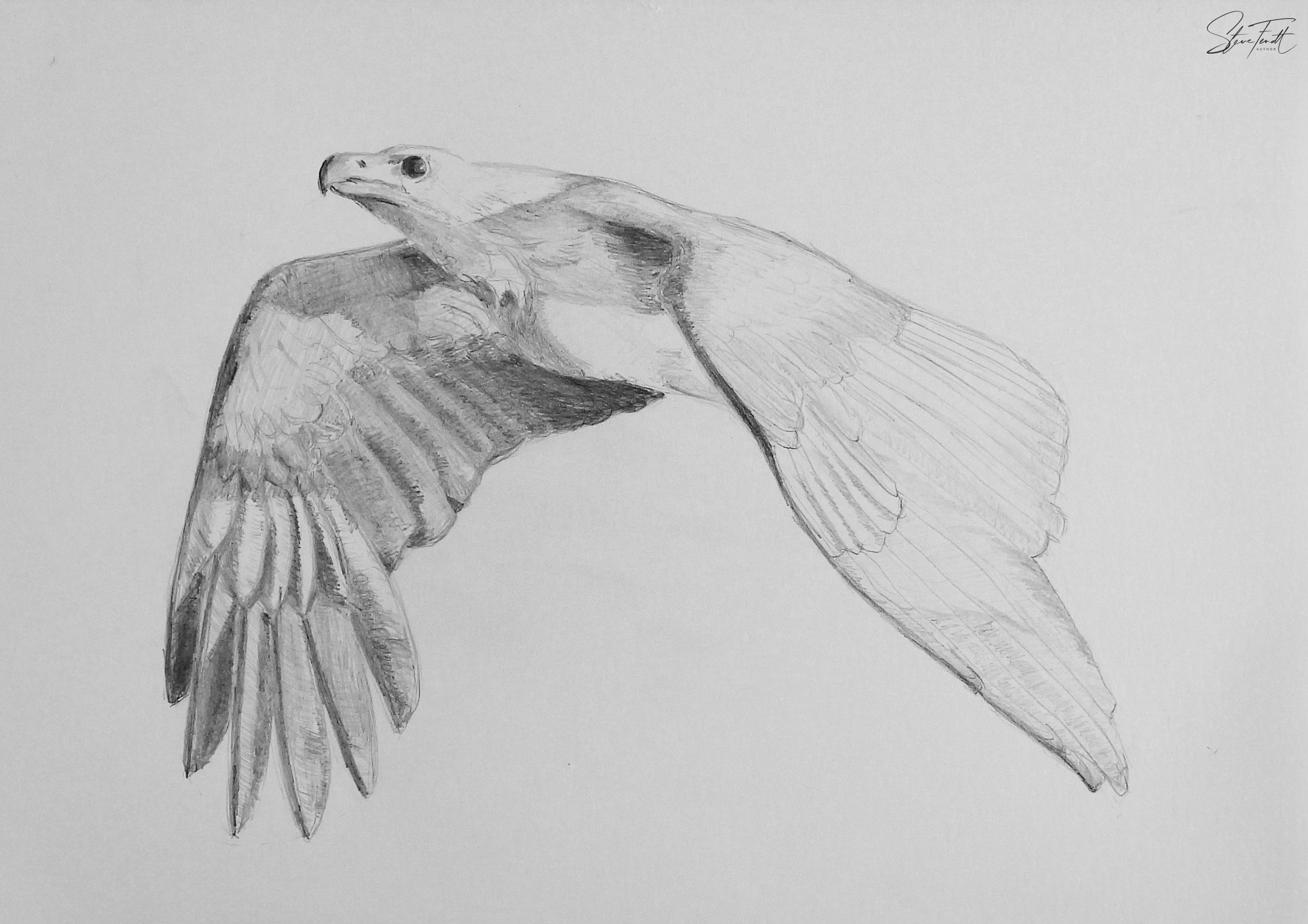
Before me is the broad curve of the river mouth. High in a huge blackwood stag on the opposite bank, the sea eagle pair are getting ready to nest. He’s fussing at the great mound of sticks and branches they’ve built in the fork of the long-dead tree, probably over decades; she’s flying a hunting sortie low across the river. Occasionally they honk their contact calls to each other. A bit like Maya and me on the radio. The thought makes me laugh.
Other than my dear wife, who’s using the wild weather for a lab day back at the Pod, putting yesterday’s samples under the microscope, I’m probably the only human being within a radius of many kilometres. Okay, so there could be a hardy crew of Parks volunteers out there somewhere, repairing paths – but in the winter, it’s unlikely.
This inlet is gloriously isolated and lonesome nowadays, but for a brief period at the turn of the twentieth century it was a busy little place, supporting tens of people, including families with children. It’s difficult to visualise, even when you’ve seen the photos, and stumbled over piles of mossy stones and the odd sawpit, hidden in the thick brush.
The ‘piners’ I mentioned earlier require some explanation for those of you not from Tassie. It’s the name we give to the lumberjacks who specialised in that most valuable of Tasmanian timbers: Huon pine. Buoyant yet dense, easily worked, rot-proof on account of its remarkable oils, it’s the boatbuilding timber par excellence.
Your Huon pine doesn’t care at all for salt water or salt-laden winds. It likes the dank, still forests along the upper reaches of this region’s myriad rivers and creeks. It’s immensely slow-growing, yet because it lives for millennia, it can attain immense girth. The narrow growth rings of its long, slow life produce a fine, straight-grained timber, which has almost no useless sapwood. A Huon pine log will happily lie in the boggy ground for a hundred years – and then be as fresh and ready to work as the day it fell.
So the piners pressed their way upriver through this unforgiving terrain, enduring appalling conditions, to reach the timber stands. They felled the pines next to the water first, then created skidways and chutes to bring the less accessible logs to water. The logs would sit in the river and wait for the next flood to carry them down to the mouth. Right where I’m sitting now, they would be brought ashore, squared off or sawn into planks, and shipped to Hobart – or used in situ to build fishing smacks and coastal traders.
The settlement dwindled with the stands of pine. The last permanent inhabitants of this inlet were the Claytons, Winsome and Clyde, who lived here seventy-odd years ago, fishing and tending the light beacon on the point. After enduring the lashing gales and big swells for fourteen years, they took down their house and moved it inland: to the big, landlocked basin on the other side of these hills to our east, not far from the airstrip Win’s brother constructed single-handedly over three summers. That unmanned strip of white quartzite is still the area’s main connection with the outside world, visited by a light aircraft once a day, weather permitting – which it often doesn’t.
Okay, time to go sort out those buoys. Laterz, my imaginary friends.
I’ve paddled upriver as far as the first gorge and back again, turned off all the buoys inside the break. And it’s not even lunchtime yet. So …
‘Pod Princess, this is Aquaboy. Over.’
‘Station calling “Pod Princess”, this is Poynduc Base. Please use standard identifier or call sign. Over.’
Well, that’s me told.
‘Poynduc Base. This is Poynduc One. Surf’s down a bit. Gonna have a crack at the break. Over.’
‘Mitch! Don’t take unnecessary risks! Over.’
‘Sorry, sweetheart, you’re breaking up. Gotta go. Aquaboy out.’
Look, I know my limits and I’ve studied this particular break for weeks, okay? It’ll be fine. Though I have to admit: nothing gets the adrenaline pumping more than punching my kayak through big, breaking waves, being careful to maintain speed and not get broached and tumbled.
All the while keeping an eye out for that floating tree I saw earlier …
Holding back, holding back, waiting for the right set of waves, because once I’ve committed, there’s no turning around …
Now! Go for it! Paddle like buggery! Through the first one as the lip starts to curl and break. Keep your momentum and smash through the second, bigger wave coming in on the back of the first. Sneaky … Don’t fall into the trough, or your bow will dig in and you’ll pitchpole. Gather your breath, power up again and POOM! through the third in a welter of spray … Keep going, keep going. Can’t let ’em stop you dead …
… and here we are, out in clear water. See? That wasn’t too bad, was it?
Okay, so there were a few hairy moments there, strictly between you and me and the GoPro. What would life be, without a few thrills and spills, eh? And some good footage for our website …
I’m bloody loving this project. Mine isn’t exactly an office job, but I’ve never before experienced such a sustained level of exertion in the exercise of my profession. Maya and I agree we’ve never in our lives felt fitter than these last months.
In case you’re wondering: we do have a ‘proper’ boat: a RIB with a small but capable electric motor. The problem is charging it from our meagre supply. Also, the kayaks are more versatile for daily use. We only use the RIB once a month to go pick up our supplies from the airstrip – an eight-hour return journey – and as a platform for scuba diving.
None of our vessels are suitable for the open ocean, so the airstrip and its expensive flights are our only transport connection with the outside world, and satellite internet is our only means of finding out what’s going on out there.
All done. The whole network successfully powered down. Not gonna lie: I’m feeling pretty damn pleased with myself. Time to head for home.
But hello – the love of my life isn’t looking too thrilled to see me, standing there on the beach with her arms folded. I see a dangerous squall coming.
‘Mission accomplished, darl!’ Might as well brazen it out.
‘I watched you out there in the surf,’ she says, holding up her binoculars. ‘You take too many risks, Mitchell Davies. There’s nobody going to come and rescue us, you know. And it’s not just yourself you should be thinking about. We’re in this together, remember?’
‘Yeah, you’re right. Sorry.’
And she is. I can see that’s not the only thing on her mind, though.
‘Update from NOAA, just come through. The CME’s going to hit this evening, about eight p.m. local time. And it’s big. Huge. Possibly the biggest ever, since records began.’
‘Ah. Doesn’t sound good.’
‘You’re a master of understatement, my love. We’re in uncharted territory. I’m scared, though I’d be pushed to say exactly what of. The unknown, I guess …’
That hits home. I’ve never known Maya to be scared of anything. Cautious, yes. Prudent, always. But not like this, with this look in her eyes.
It brings home to me how much I rely on her. She’s my rock, as they say. And when your rock trembles in your arms, you take notice.
Seven thirty, and we’re waiting on the beach, nervous but expectant.
The cloud cover has blown away with the passing of the cold front, leaving a cold, clear night. There’s no light pollution at all, in this most isolated of spots. The Milky Way shines clear and brilliant.
Ah, here we go. A faint, pinkish glow on the southern horizon, an eerie green tinge at its edge. Before long, ribbons of magenta and green are curling their way up to the zenith.
Eventually the whole night sky above us is ablaze, from horizon to horizon. Transparent veils, curiously blurred like they’re not quite in focus, with shifting vertical folds like a curtain blowing in the breeze.
The sky’s broken image is reflected in the water at our feet.
I’ve never seen the Aurora in this intensity. I have to admit: not even on Macquarie Island, and that’s ten degrees further south. Stupendous.
It seems weird that something so big and dynamic should be silent. I’ve just realised I’m straining my ears to hear swooshing noises. But there aren’t any, just the crash of the surf like always, and the call of our local boobook owl from the brush nearby.
Nearly eleven now. We did plan to stand and watch the whole spectacle, but the cold has seeped up through the soles of our winter boots, and slipped in around the collars and cuffs of our down jackets, to chill us to the marrow. Guess we’re gonna call it a night. On with our headlamps and back up to our nice, warm Pod …
I have an illogical feeling that we’ve weathered the storm. What was I expecting to happen, exactly? The Rapture?
We’re itching to know what’s going on with Starlink, whether we still have internet, but on the other hand it seems prudent to leave it turned off until the morning. Just to be on the safe side.
Maya points out that the main danger is currents induced in long wires – as in the electricity grid, the nearest point of which is seventy kilometres away at the Gordon Power Station. She says the worst that can happen to our Starlink transceiver is that the incoming signal gets scrambled by the space weather.
But I’m just a humble marine biologist, right? And as such, I understand surf breaks a lot better than the uncanny properties of electromagnetic radiation and charged particles. My instinct is to lie low in our cosy little Pod, snuggle up in bed, and keep our precious comms turned off until the big, bad cosmos sorts itself out.
To my surprise, she humours me. Uncharted territory, after all …
Goodnight all!
Title illustration ‘White-bellied Sea Eagle’: pencil on Bristol paper. These huge, glorious birds are not uncommon on the remoter parts of the Tasmanian coast. I saw (and heard) several during my weeks in Poynduc / Port Davey, including at the mouth of the Davey River, as described in the story.
Wouldn't that be a sight!
Love the sea eagle.
I can almost picture the place where this story is set. I would've loved to see that sky display!