
The Devil's Chord – Chapter 17
Fortune
On Tuesday morning, I wake late – and exhausted. The nine hours of oblivion seem to have done me no good at all.
Ken’s already up, and announces he’s going to cook us a big brekky.
‘Reckon we deserve a good feed, after all that, eh, love?’
I can’t think of much I want less, but I lack the energy to dampen his enthusiasm.
While he’s bustling in the kitchen I scan my social media, Hell ’n’ High Water’s social media, regional and national news feeds. No news of Toby Reid. No news of a touring US musician being taken ill at all, anywhere in Australia.
With yesterday being a travelling day, then settling in to their accommodation in Geelong, they might not have had time for rehearsals, I reason.
Breakfast is ready. Home-baked sourdough, eggs from our chooks, spinach from our garden, last season’s tomato relish. It tastes like ashes, but I choke down half my plateful to please him.
He looks sad.
While we drink our coffee, he reads me yesterday’s paper. I try to show interest, but I know it’s a poor performance.
Ruth Onyango’s article. Though my focus is frayed, my mind agitated and preoccupied, I register that it isn’t what I expected. Not at all.
It’s an almost whimsical piece, very personal. It emerges that Ruth is an accomplished folk singer and guitarist herself. She never told me, and I never thought to ask.
She tells the tale of the weekend from her perspective: from meeting the organisers and chatting to locals, through the build-up, to the big event itself. The performances, the firelight jams, the good humour. Some character sketches: affectionate, wry and funny. An evocative review of Toby’s first-night performance.
It’s one young female musician’s journey from scepticism to at least grudging appreciation of an oft-ignored, sometimes maligned genre. A portrait of an embattled musical community held together by love and dogged, if eccentric, commitment.
After breakfast, I’m desperate for anything to occupy my mind and body for the rest of the day. Notwithstanding my aching muscles from climbing the mountain yesterday.
So I announce that I’m going to tackle the old, dead apricot tree in our orchard. It’s been sick for some years with gummosis; last winter’s hard frosts finally did for the gnarled veteran, one of the first trees we planted when we came here. The diseased wood needs removing before the infection spreads to other trees.
Ken offers to help, but I insist that the animals need him more. Besides, I want to do this myself.
I’ll break the cankerous old tree down with the chainsaw and loppers, then put it through the chipper. Finally, I’ll build a hot compost heap, sterilising the mass of chips by bringing it up to seventy degrees C and keeping it there for a week. For that I need plenty of high-nitrogen material to mix with the wood, and a couple of hundred litres of water.
By way of compromise, I allow Ken to muck out the chooks, the pigs and the donkeys, and barrow the manure down to the orchard where I’m going to build the heap. All that shit and a big pile of kikuyu and nettles garnered from the creekside will be my nitrogen.
Cutting down the tangled, twisted old apricot is a hellish task. No wonder we’ve been putting it off since the start of spring. By mid-afternoon my bare arms and legs are covered in scratches, my hair reeks of sweat and petrol fumes, and I have woodchips in unlikely places. But the apricot tree is gone. Enough of a stump for Ken to drag out later with the neighbour’s tractor; that’s all.
A quick break to force down a sandwich and a mug of tea, then on with building the heap. I’m a bloody good hot composter, if I do say so myself, and this heap’s going to be a beauty. It’ll give us a couple of hundred kilos of good compost, as long as I keep up with the turning when it gets up to temperature. Upside down and inside out – every day until it starts to cool down. Exhausting, muscle-tearing work.
Exactly what I need.
By dinnertime I’m so done in, I’d throw up if I had the energy. Still, I scan the band’s social media pages again. Nothing.
Then Ken and I settle in for the evening, and we drink. And drink. Like in the old days. Back when we didn’t know better, didn’t care, and didn’t mind dying young, because old age was a wholly abstract concept.
I wake on Wednesday morning, pick up my phone, force my swimming eyes to focus … and the nightmare still isn’t over.
No news. Nothing on social media beyond photos of what was clearly a successful, sell-out gig. Photos of the band in the departure lounge at Tulla. Toby looking a little tired, perhaps, but otherwise in the best of health.
And then … and then … oh, for God’s sake cut to the chase, Megan Newell!
And then … inexplicably, maddeningly and yet to my intense relief … nothing happens.
At least, nothing bad happens to Toby Reid. The band go their separate ways for the holidays, to their different corners of the USA. Photos of Toby and his extended family at their laden Thanksgiving table. They look happy. Toby seems to be loved.
Later a Christmas card arrives in the mail, with a US stamp. It shows a pretty view of Paducah, KY. Painted by a local artist, according to the text on the back. Ken looks up the place online. It looks a sweet little town, at the confluence of the Tennessee and the Ohio River. The sort of place we’d have liked.
‘Banks of the Ohio’ … a beautiful ballad, but I remember how we despised the protagonist. The murderous lover was a man in the original, but I always hear it in Joan Baez’s vibrato.
On New Year’s Day, Niamh flies out to New York. We have a teary farewell at the airport. But why, in fact? We’ll probably still see her twice yearly. Maybe it’s the psychological distance.
We institute weekly calls, but they soon dwindle. She’s busy, Ken’s never good on the phone, and I have little to say, because the one huge thing I can’t say blocks my throat and stops my mouth.
That much pent-up emotion isn’t healthy.
So in the end, instead of Toby getting sick, it’s me.
The panic attacks increase, become truly frightening. I can’t sleep at night, then shuffle around like a zombie during the day, doze at odd moments but find no refreshment. Develop narcolepsy that makes it unsafe for me to drive. Experience hallucinations. I try not to look in the mirror, because the haggard mask that stares back at me isn’t my face.
Anxiety, says Lydia, my GP. Prescribes me sedatives and refers me to a psychologist. Cautions me against home remedies: she knows my naturopathic tendencies. Advises me to stop drinking.
So much for ‘substituting our preferred reality for what actually happened’. Maybe Toby can do that, with an easy conscience – but I don’t get to. Instead, I substitute a waking nightmare.
How could I have done something so stupid, thinking I was being cunning? I envisage scenes in which Toby lends his poisoned string lubricant to the whole band – and I wipe them all out in the course of one gig. Glassy-eyed bodies strewn across a stage or a recording studio.
I tear up the referral: how could I possibly be candid enough for therapy to be of use? Anyway, I deserve to suffer. In trying to avert an evil, I’ve brought a greater evil into the world.
That’s the kind, the poetic interpretation, at least. Maybe I was just lashing out, another jilted lover who couldn’t accept rejection and turned violent. How commonplace; how contemptible.
Ken is endlessly kind and supportive, in his taciturn way. Prepares meal after delicious meal to tempt me. I push most of them away after a few mouthfuls.
Then, as the months and seasons pass, imperceptibly at first, I get better.
It’s become clear that nothing has come of my murder attempt. Nothing will ever come of it. Maybe I got the concentration wrong? Maybe the oils in the lubricant have neutralised the aconitine somehow? Maybe Toby noticed the changed viscosity, figured the lubricant was rancid and binned it? Maybe he lost the applicator?
It’s as if I’ve awoken from a fever dream.
How could I have lost all sense of proportion in this way? Unkind words don’t deserve a vial of poison; not even when they come from someone we used to love. My daughter doesn’t need me to defend her virtue by killing her lovers.
If that’s what Toby even was, or had designs to be. I gather they haven’t met up in months, and there are hints of a new man on the scene, someone from the orchestra.
In these days of our obsession with ancestry, finding our past, discovering obscure branches of our families, yanking those skeletons right out of the closet and dusting them off, displaying them for all to see, parentage can’t be hidden. People are having DNA tests right and left – and damn the consequences. If there’s anything awful to find, Niamh, Ken and Toby will find it sooner or later.
I can’t help that – and it wasn’t my fault. It was probably nobody’s fault. Anyway, Ken will always be Niamh’s father, regardless of whose sperm fertilised my egg.
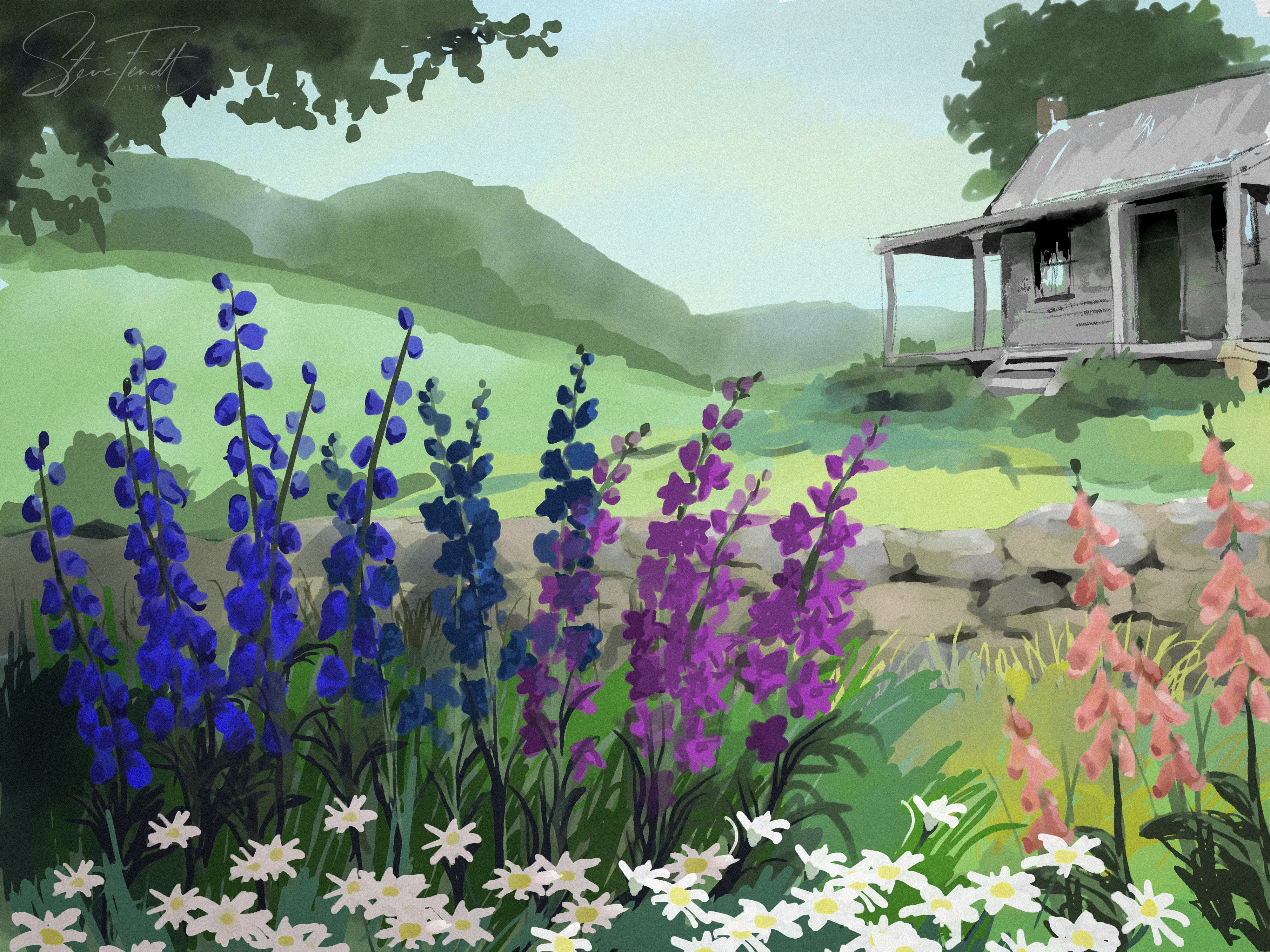
By the time November comes around again, the garden is blooming and the larkspur, the foxgloves and the monkshood again grow tall and stately. The Pick is imminent, and this year, the Cropdusters really are coming – fingers crossed.
I’ve stood down from my committee post: Ken and I are just common-or-garden volunteers, no heavy weight of responsibility.
I feel at peace – and grateful.
It’s gratitude for my own ineffectuality. I tried to do something awful – and failed. Isn’t that the greatest good fortune any of us can wish for?
THE END
I hope you enjoyed The Devil’s Chord. Thanks for reading!
Title image ‘Meg’s Garden’: drawn freehand by the author in Adobe Fresco.
Great writing, Steve and beautifully read, Susan. I love the story, and it's a perfect. ending.
I was beginning to think it was Niamh who was going to get poisoned 😲 Nice twist, Steve. I enjoyed that tale.